Stories that shift power: Growing community reporting in Greater Manchester
We brought community groups, researchers and public sector partners together to explore how community reporting can flourish across Greater Manchester. In this blog, Emma shares what we heard, what could help it grow, and why telling our own stories matters for shifting power closer to communities.
Stories that shift power: Growing community reporting in Greater Manchester
We brought community groups, researchers and public sector partners together to explore how community reporting can flourish across Greater Manchester.
In this blog, Emma shares what we heard, what could help it grow, and why telling our own stories matters for shifting power closer to communities.
Author
Emma Ansell-Meehan, Strategic Lead
Published
Type
10GM Blog
Theme
Live Well

Last week, a diverse group of around 40 community groups, researchers, VCSE infrastructure organisations, participation practitioners, and public sector partners came together at the Proud Trust community café to explore how we create the conditions for community reporting to flourish across Greater Manchester. Thank you to the Proud Trust for hosting, and to everyone who took part!
We focused on people furthest from power, and on how community reporting can build power, influence decisions and change systems. The morning combined discussion, creative exercises, reflection and ambition setting.
So why did we decide to come together in this way?
Traditional journalism has often been shaped by a fairly narrow set of perspectives. Traditional media outlets are often led and owned by those from white, middle-class and privately educated backgrounds. Journalism plays a vital role in informing society, but it can’t be the only way our stories are told. Often those stories are interpreted, edited and presented through someone else’s lens.
In contrast, community reporting is about resourcing people with the power and agency to tell their own stories, in their own words, from their own lived experience.
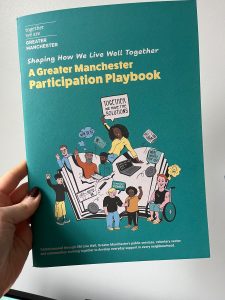
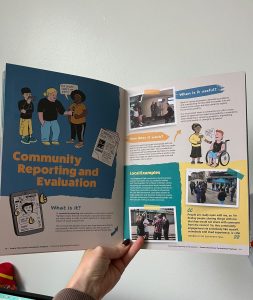
As defined in the Greater Manchester Participation Playbook:
“In community reporting and evaluation, community journalists highlight issues that are meaningful to people whose voices are rarely heard, in order to inform decisions or measure the impact of public programmes. This ensures that people’s stories and experiences are directly represented in decision-making spaces and that issues are communicated on an emotional level as well as through data.”
Rather than asking communities what they think and then interpreting their responses, community reporting enables communities to become the storytellers, investigators, documenters and changemakers themselves.
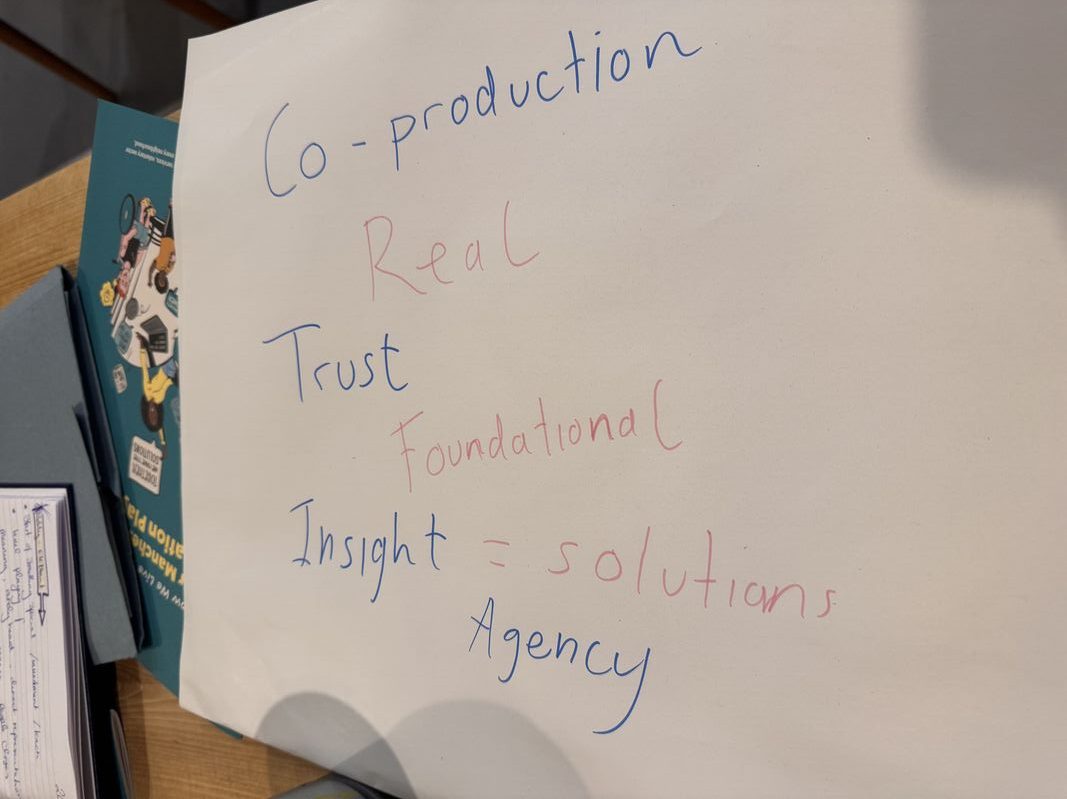
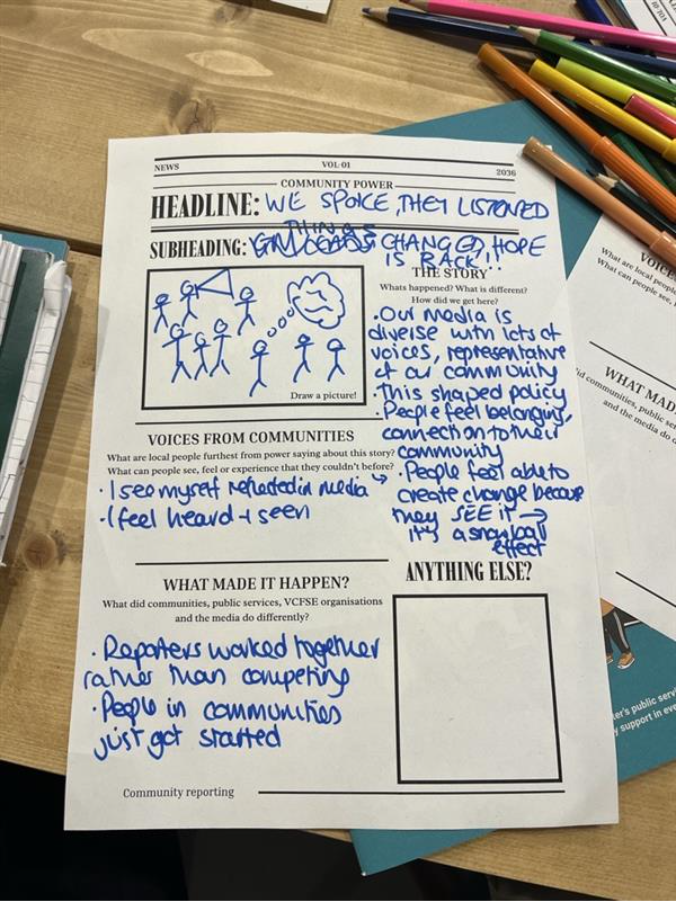
After coffee and pastries, we transformed the room into a temporary newsroom. We introduced ourselves, our organisations and, in a single word, why we cared about community reporting. We were then invited to imagine a future where community reporting was thriving across Greater Manchester, and completed a newspaper front page answering the following question:
If community reporting was working brilliantly in five years’ time, what would be different?
Some of the headlines included:
‘Bridging the chasm’ and ‘We spoke, they listened!’
Next, using a ‘gardening’ metaphor, we mapped the existing landscape of community reporting across Greater Manchester, and it was really clear that we’re not starting from scratch- we can already see many small gardens of community reporting blooming across Greater Manchester.
What helps it flourish
Not starting from scratch: we can already see many small gardens of community reporting blooming across Greater Manchester. The conditions that help them grow include:
- Capacity building such as skills workshops, mentoring opportunities and peer-to-peer learning
- Sustained investment, including resources for equipment, training and meaningful payment for people contributing their lived experience.
- Courage and creating environments where people feel trusted, supported and confident enough to share their experiences and challenge existing narratives.
- The time it takes for high-quality stories to be created
- Distribution networks across communities and into formal decision-making systems, helping stories travel further and influence action.
- Advocacy and system buy-in, as we can only create change when decision-makers engage with them.
What gets in the way
Alongside these opportunities, we identified several barriers. These included
- Lack of knowledge and buy-in, as some decision-makers still do not fully understand the value of community reporting or how it differs from more traditional consultation approaches.
- Short-term or competitive funding, which creates instability and makes long-term planning difficult.
- Narrow system priorities and the risk of reporting becoming driven by institutional agendas rather than community priorities
- Censorship and control, as sometimes we see communities being invited to share stories only when those stories align with existing narratives or organisational interests.
How can we ensure community reporting thrives?
The final creative exercise returned to our gardening theme. Each of our tables became gardening teams, designing landscapes that would allow community reporting to thrive. We created forests, rivers, butterflies, flowers, roots and pathways representing different forms of support, infrastructure and collaboration.
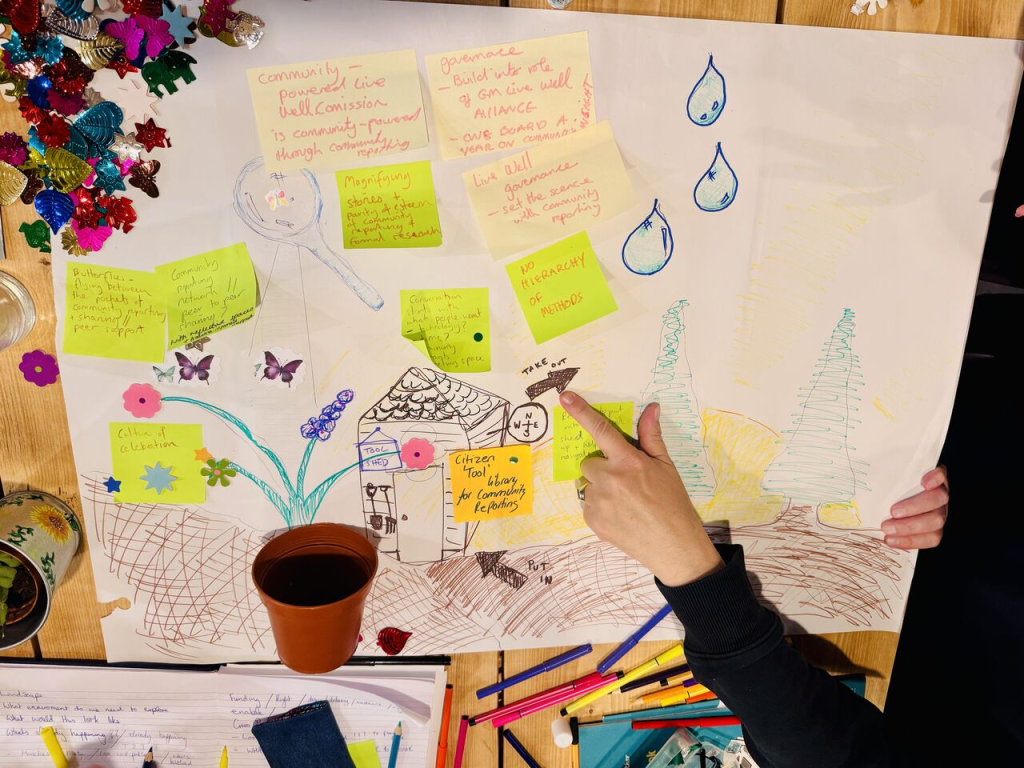
What happens next?
Finally, we looked at some practical ideas that could be taken forward- these are going to be developed by some of the people in the room, and shared with a bigger group of people at the upcoming Greater Manchester Participation Playbook: One Year On event.
My personal takeaway is that Greater Manchester already has many of the ingredients needed to grow a thriving community reporting movement. What we need to do now is to connect people, strengthen relationships, share resources and create the conditions for community reporting to grow in every borough of Greater Manchester.
If Live Well is about shifting power closer to communities, then community reporting has an important role to play. It gives us all agency over how, why, and for what purpose our stories are told. By working together, we can grow the visibility of community reporting, ensure it is respected and valued just as much as other types of intelligence and data, and create a new, community-powered narrative about what it means to live well in Greater Manchester.
Be part of it. Come and join us at the Greater Manchester Participation Playbook: One Year On event
13:00-16:00, Wednesday 25 November 2026 at The Monastery Manchester, Gorton Lane, Manchester M12 5WF
About the author
